Share


Rapid and accurate object detection in UAV remote sensing applications takes a leap forward with research from Osaka Metropolitan University
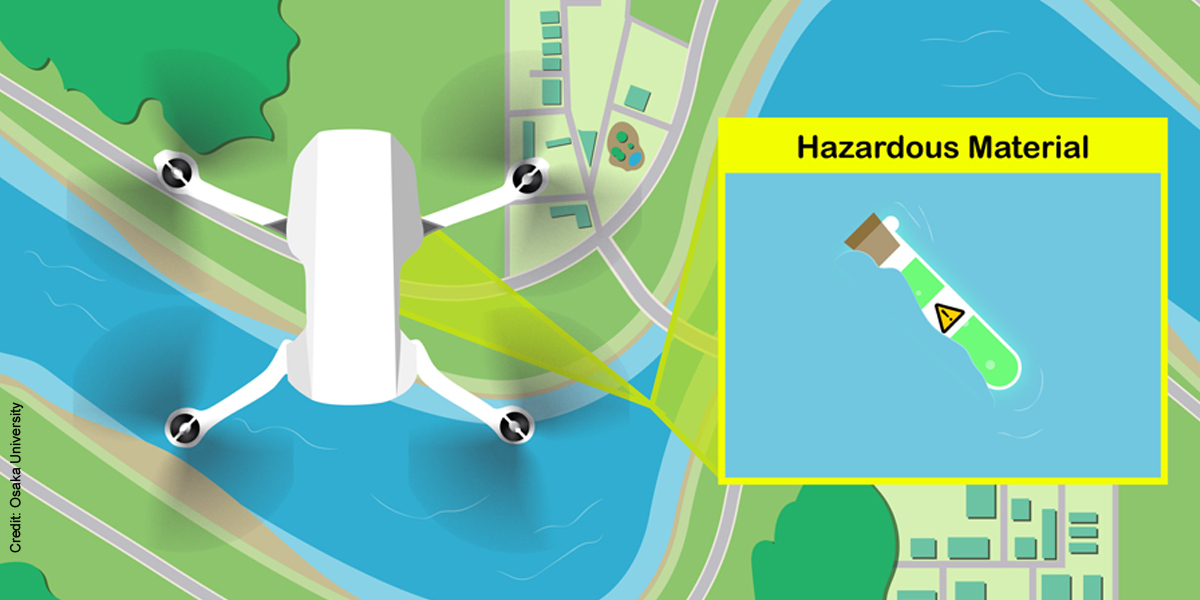
Remote sensing object detection is a rapidly growing field in artificial intelligence, playing a critical role in advancing the use of unmanned aerial vehicles (UAVs) for real-world applications such as disaster response, urban planning, and environmental monitoring. Yet, designing models that balance both high accuracy and fast, lightweight performance remains a challenge.
UAVs often capture images where objects appear in different sizes, angles, and lighting conditions, all while operating on devices with limited computing power.
This creates the need for innovative deep learning models that can deliver robust results without relying on heavy computational resources.
To address these challenges, a research team from Osaka Metropolitan University, led by graduate student Hoang Viet Anh Le and Associate Professor Tran Thi Hong with her collaborator team, has developed a novel detection framework tailored for UAVs. The research is published in the journal Scientific Reports.
At the core of this work is the Partial Reparameterization Convolution Block (PRepConvBlock), which reduces the complexity of convolution operations while maintaining strong feature extraction. This innovation makes it possible to use larger kernels, enabling longer-range feature interactions and significantly expanding receptive fields.
Building on this, the researchers introduced a Shallow Bi-directional Feature Pyramid Network (SB-FPN), which fuses information between shallow and deeper feature scales to enhance visual representation.
These innovations come together in a new architecture named SORA-DET (Shallow-level Optimized Reparameterization Architecture Detector).
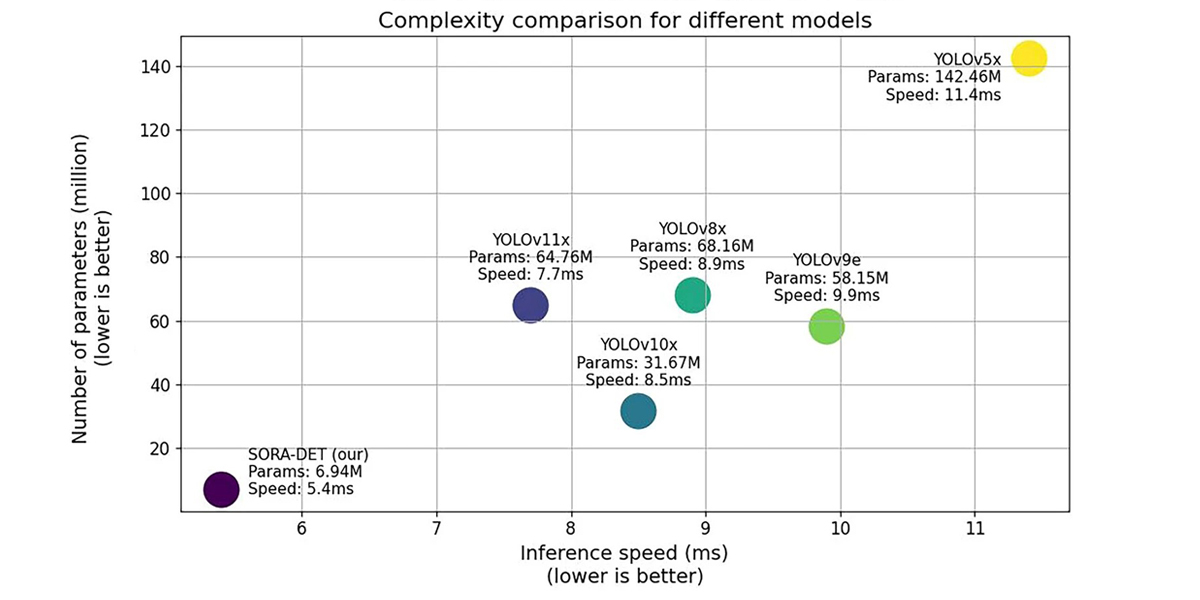
The complexity of various one-stage detectors ranges from resource consumption to computation cost. Apparently, the SORA-DET consumes the lowest number of parameters with extremely low inference speed, making it more suitable for remote sensing object detection tasks on low-platform devices. Credit: Osaka Metropolitan University/Scientific Reports .
In fact, SORA-DET requires nearly 88.1% fewer parameters than conventional one-stage detectors, with an inference speed as fast as 5.4 milliseconds.
This combination of compact design, high detection performance, and real-time adaptability makes SORA-DET a promising solution for UAV-based remote sensing.
By enabling accurate object detection on lightweight devices, this research opens the door to impactful applications in disaster management, search-and-rescue operations, and beyond.
More information: Minh Tai Pham Nguyen et al, Partial feature reparameterization and shallow-level interaction for remote sensing object detection, Scientific Reports (2025). DOI: 10.1038/s41598-025-14035-7
Journal information: Scientific Reports
Story Source: Osaka Metropolitan University
Subscribe to our newsletter
Stay updated on the latest technology, innovation product arrivals and exciting offers to your inbox.
Newsletter